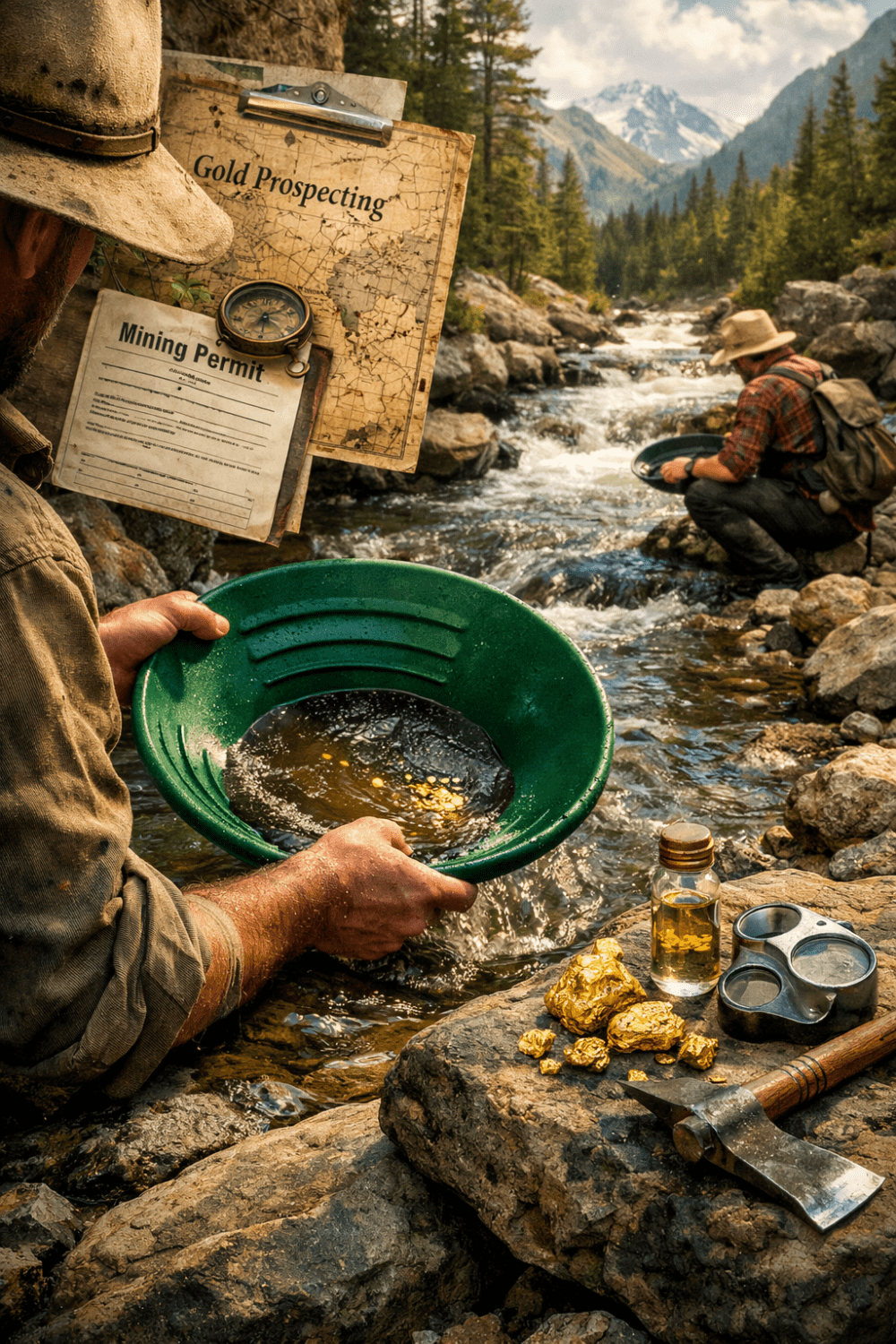
If you have been thinking about gold panning—maybe you saw someone do it on a trip, maybe a friend mentioned a creek, maybe you just like the idea of finding something real in moving water—the first thing worth knowing is that you are not crazy for being curious. Gold panning is the simplest, cheapest, most accessible way to look for gold. It has been done for thousands of years, on every continent where rivers carry sediment, by people with nothing more than a shallow dish and some patience. It is still done today, and in the right places, under the right conditions, it is perfectly legal and genuinely enjoyable.
The second thing worth knowing is that there is a gap between the idea of gold panning and the practice of it. Not a dangerous gap. Not an expensive one. But a real one, involving questions like: Where am I allowed to do this? Whose land is this? Do I need a permit? What am I going to find? This article will answer those questions and more, and by the time we’re done, you’ll find a river to go gold panning near you!
What Gold Panning Is and Why It Works
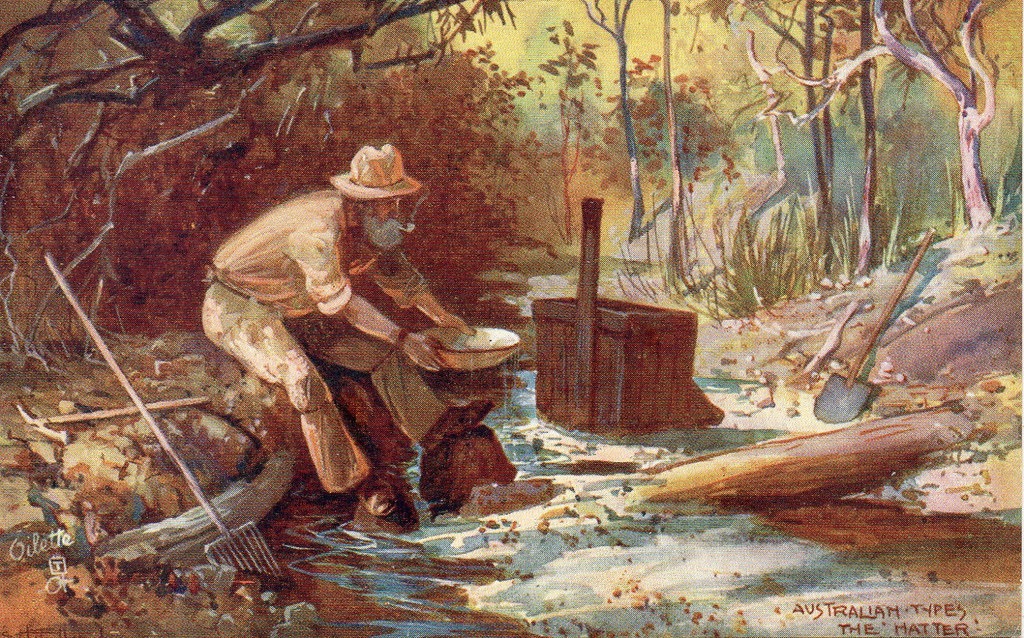
Gold panning is the most basic form of placer mining. “Placer” just means gold that has been eroded out of hard rock and carried by water into stream sediments, gravel bars, and alluvial deposits—loose material, as opposed to gold still locked in a vein underground.
The method works because gold is heavy. Unusually heavy. It has a specific gravity of about 19.3, which means it is roughly seven times denser than the sand and gravel around it. When you put a scoop of streambed material into a pan, add water, and swirl or shake it, the heavy stuff sinks and the light stuff rises. You wash the light material away gradually, and what remains at the bottom—if anything does—is your concentrate: black sand (mostly magnetite and ilmenite), and sometimes gold.
That process is called stratification, and it is not a trick or a technique unique to gold prospecting. It is basic physics. Anyone can learn it in an afternoon. Mastering the wrist motion takes longer, but competence comes quickly. The tool does not require strength. It does not require youth. It requires a willingness to get wet and a tolerance for repetition.
A Brief History, and Why It Matters to You
The history of gold panning is seemingly as old as time itself, as people have been panning for gold since ancient Egypt and Rome. Spanish colonial miners used panning and simple sluice methods across South America in the 1500s and 1600s. But the image most of us carry in our heads comes from the California Gold Rush of 1848 to 1855, when tens of thousands of people—called forty-niners—headed west with gold pans as their primary tool.
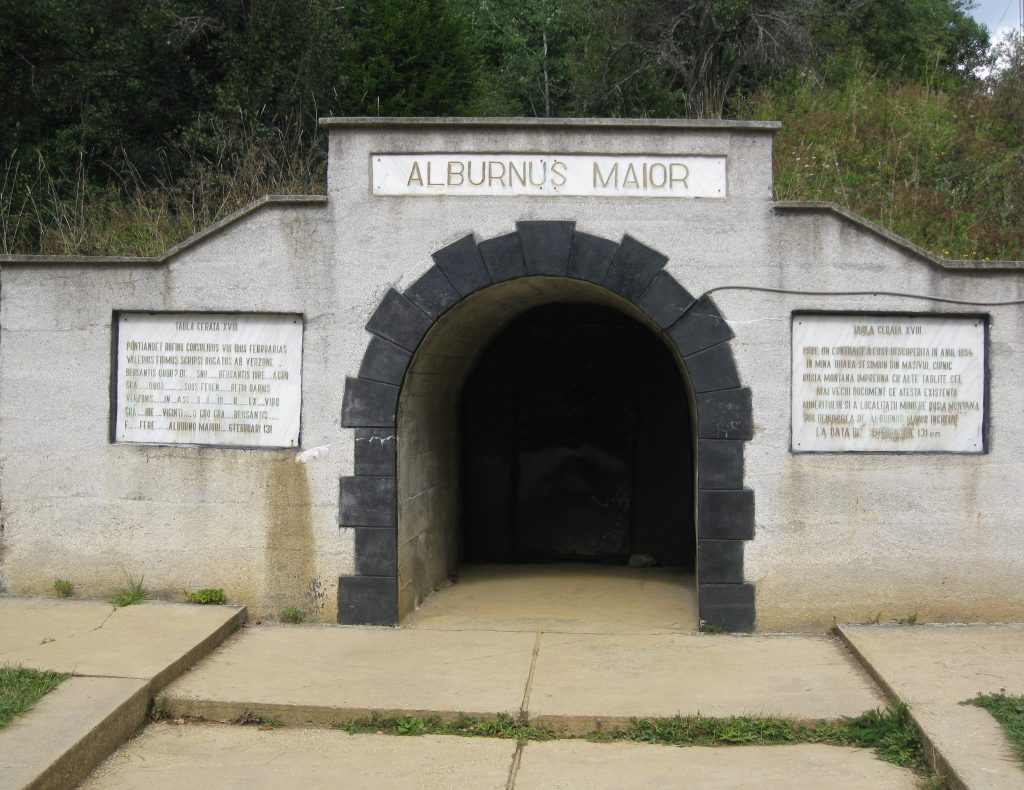
Similar rushes followed in Australia, British Columbia, the Yukon, and Alaska. In every case, the pan was the starting point. When the easy surface gold ran thin, prospectors moved to sluice boxes, rockers, and eventually industrial-scale hydraulic methods. The pan did not disappear. It just returned to what it had always been: the first tool, not the last.
Why does any of this matter if you are standing in your kitchen reading this on a phone? Because historic gold-rush areas are often the same places where recreational panning is allowed today. The geology that drew those early prospectors is still there. Rivers still move sediment. Gold still concentrates in the same kinds of places it always has—inside bends, behind boulders, in cracks in bedrock, in riffles where the current slows. Knowing a little history helps you understand why certain areas are popular, and why certain creeks show up on every “best places to pan” list.
It also helps you keep your expectations honest. Those forty-niners cleaned out the richest, most accessible deposits a hundred and seventy years ago. What remains is real, but it is not what it was.
Where You Can Do This—and How to Find Out
This is the part that stops most people, and it does not need to. The question of where you can legally pan for gold has a clear answer in most cases. A lot of “best place for gold panning” lists are really just popularity lists. What you want is good gold ground you can reliably and legally pan – places where land manager, land status, claim status, and local rules all line up.
Start with land status. In the Western states—California, Oregon, Washington, Montana, Colorado, Alaska, and others—large areas of land are managed by federal agencies, primarily the Bureau of Land Management and the U.S. Forest Service. Some of this land is open to recreational mineral collecting, including hand panning, under relatively simple rules. In the Eastern states, most land is privately owned, which means you need the landowner’s permission.
Next, check whether the specific area you are interested in is open to mineral entry. Not all public land is. Wilderness areas, national parks, certain wildlife refuges, and other protected designations are typically closed. The land management agency’s local office can tell you, and their websites often have maps showing which areas are open.
Then check whether someone else already holds a mining claim on that ground. If they do, you cannot pan there without their permission. Mining claim records are publicly available through the BLM’s MLRS database and through county recorder offices. It takes a few minutes to look up, and it is worth doing before you drive two hours to a creek and have to make a turnaround.
Finally, check local rules. Some areas allow hand panning but prohibit motorized equipment, sluice boxes, or any disturbance to the streambed beyond what a pan creates. Some states require a simple recreational mining permit or a state prospecting license. California, for example, has specific regulations around suction dredging that do not apply to hand panning but can cause confusion if you do not know the distinction.
If this sounds like a lot of steps, consider it this way: you are checking four things—land manager, land status, claim status, and local rules—and each one has a clear place to look. Most of your information will come from the BLM’s MLRS. Once you have done it for one area, you know how to do it for any area. The process is the same everywhere. Only the answers change.
What You Need to Get Started
The equipment list for gold panning is short, and almost everything on it is inexpensive.
You need a gold pan. A standard pan is 14 inches in diameter, made of plastic or steel, often with small ridges or riffles molded into one side to help trap fine gold. Plastic pans are lighter and easier for beginners because you can see gold against the dark surface. A decent pan costs somewhere between ten and twenty-five dollars.
You need a classifier—a screen that sits on top of the pan and filters out rocks and debris larger than a certain size before you start panning. This saves time and improves your results. Classifiers cost about the same as pans.
You need a small shovel or garden trowel for digging material from gravel bars and stream margins. You can use your hands, but good luck breaking through tough ground. You need a few small vials or bottles for storing anything you find. And that is the essential list.
Beyond the basics, a snuffer bottle is useful—it is a small squeeze bottle that lets you suck up individual gold flakes from your pan without fumbling with tweezers. A magnet helps you separate magnetic black sand from your concentrates. A hand lens or magnifying loupe helps you identify what you are looking at. None of these are expensive, and none are required for your first outing.
You do not need a sluice box, a highbanker, a dredge, or any motorized equipment to pan for gold. If someone is telling you that you do, they are either selling equipment or talking about a different activity.
How to Pan: The Basic Process
The physical process of gold panning is easier to learn by watching than by reading, and there are good demonstration videos available from prospecting clubs and geological societies. But the sequence is worth understanding before you try it.
You start by choosing where to dig. In a stream, gold tends to settle where water slows down: on the inside of bends, behind large rocks, in natural riffles, and in cracks or crevices in exposed bedrock. These are the spots where the current loses energy and drops heavy material.
Scoop material from one of these areas and run it through your classifier into the pan, removing the larger rocks and roots. Fill the pan about one-third to one-half full of classified material.
Submerge the pan in water—in the stream itself, or in a bucket if you are working away from the water’s edge. Shake the pan side to side with a level, vigorous motion. This is the stratification step: it forces the heavy material down and the lighter material up. Do this for fifteen to twenty seconds.
Now tilt the pan slightly away from you and let water wash across the surface, carrying the top layer of lighter sand and gravel over the lip. Go slowly. Periodically level the pan and shake again to re-stratify. Then tilt and wash again. Repeat this cycle—shake, tilt, wash—until you are down to a thin layer of dark, heavy concentrate at the bottom of the pan.
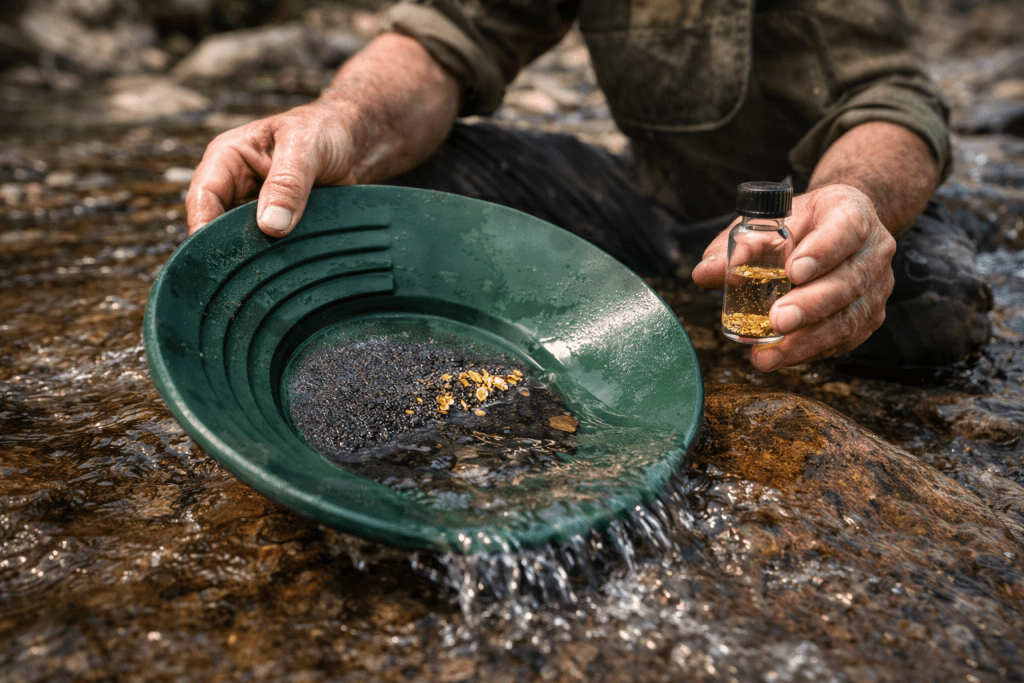
At this point, add a small amount of water and swirl it gently in a circular motion. If gold is present, you will see it: small flakes or specks of bright yellow metal sitting in the black sand. Use your snuffer bottle or a wet fingertip to pick them out and transfer them to a vial.
The whole process takes a few minutes per pan. Speed comes with practice. Losing gold over the lip is the most common beginner mistake, and the fix is simple: slow down, keep the tilt angle low, and re-stratify often.
What You Will Find—and What You Will Not
This is where honesty matters more than encouragement.
Recreational gold panners working decent ground typically recover fractions of a gram per hour. Sometimes less. Occasionally, in a good spot on a good day, you might find a small flake or two that makes you pause. Nuggets are rare in most recreational panning areas. The easy, visible gold was largely removed by the people who got there first, a century or more ago.
At current gold prices, the material value of what most hobbyist panners recover in a day is measured in single-digit dollars. Often less than the cost of gas to get to the creek. If you are approaching this as a way to make money, you should know that before you go, not after.
The value of recreational panning is in the experience itself. Time outdoors. Learning to read a stream. The patience of repetitive physical work and the small thrill of finding something real in the dirt. Many people find it meditative. Many find it addictive in a quiet way. Families do it together. Retirees take it up as a reason to spend mornings by the water. These are not consolation prizes for failing to strike it rich. They are the reason most people come back.
If that does not appeal to you, that is a perfectly valid reason not to do it. Walking away from something that is not for you is not a failure. It is clarity.
Safety, Courtesy, and Taking Care of the Ground
Gold panning takes place in and around moving water, on uneven ground, often in remote locations. The physical risks are modest but real.
Wear sturdy footwear with good grip—river rocks are slippery, and a twisted ankle two miles from a trailhead is not a small problem. Bring sun protection, water, and basic first-aid supplies. Be aware of weather upstream—flash flooding is a real hazard in canyon country, even when skies are clear where you are standing. Watch for ticks and other insects in tall grass and brush near waterways.
Environmentally, hand panning is about as low-impact as mineral extraction gets. You are moving small amounts of surface material with a hand tool and returning most of it to the streambed. But even low-impact activities can leave marks if done carelessly. Fill any holes you dig. Do not disturb vegetation on stream banks. Stay out of areas that are clearly fish-spawning habitat. Pack out everything you brought in, including any trash left by less careful visitors.
The recreational prospecting community depends on continued access to public land. Every piece of ground that gets closed to mineral collecting was usually closed for a reason, and careless behavior by a few users is one of the most common reasons. Taking care of the areas you visit is not just good ethics. It is self-interest.
A Word About Claim Sales and Pressure
If you spend time on the internet Googling this or that about finding gold, you will eventually encounter people selling gold panning claims for sale (placers) or hard rock mining claims for sale (lodes). Some of these are legitimate. Some are not. A few things are worth knowing before you engage with any of them.
An unpatented mining claim on federal land is not real estate. It does not grant surface ownership. It does not give you the right to build a cabin, fence the property, or exclude the public from the surface. It gives you the right to extract minerals, subject to ongoing compliance with federal and state regulations. If someone describes a claim using language that sounds like property ownership—“your own piece of gold country,” “private access,” “exclusive rights”—those words may not mean what they seem to mean.
Be cautious of claims marketed with pan-sample photographs showing visible gold. A photo of gold in a pan tells you that gold was present at one spot, at one moment, in an unknown volume of material. It does not tell you about the claim as a whole. It is not evidence of consistent production, reliable grade, or economic potential. It is a snapshot, and it is easy to make a snapshot look impressive.
Be especially cautious of urgency. “This claim won’t last,” “someone else is looking at it,” “price goes up next week.” Those are sales tactics, not geology. Gold has been in the ground for millions of years. It is not going anywhere this weekend. You can verify a claim’s status through BLM records. You can visit the ground. You can take your own samples. Anyone who discourages you from doing those things is not protecting your interest.
Remember: you’re free to prospect and sample on open public lands – including those that already have unpatented mining claims staked there. Check the claims out before you buy. See if you can find gold. Do you like the land? Is it easy to access? Is there really accessible water? All this matters.
If any of this makes you uncomfortable, trust that discomfort. Walk away. There are plenty of places to pan for gold for free without buying anything from anyone.
Alternatives That Are Not Compromises
Not everyone wants to navigate land-status maps and claim databases before touching a gold pan. That is fine. There are easier ways in.
Prospecting clubs exist in most Western states and many Eastern ones. They hold claims that members can access, they organize group outings, and they are staffed by people who have already answered the questions you are asking. Membership fees are modest. The knowledge base is usually excellent.
Designated recreation sites—places where a land management agency has specifically opened an area to public gold panning—exist in several states. These sites remove most of the legal ambiguity. You show up, you pan, you leave. Rules are posted.
Guided panning experiences and pay-to-pan operations are common in historic gold-rush areas. The dirt is often seeded with gold to guarantee that everyone finds something. These are tourism products, and they are honest about what they are. For families with kids, for people visiting an area and wanting to try it once, or for anyone who wants to learn the physical technique before heading out on their own, they are a perfectly good option.
None of these are lesser versions of the real thing. They are different entry points into the same activity, calibrated to different levels of commitment and risk tolerance. Start wherever makes sense for you.
Where This Leaves You
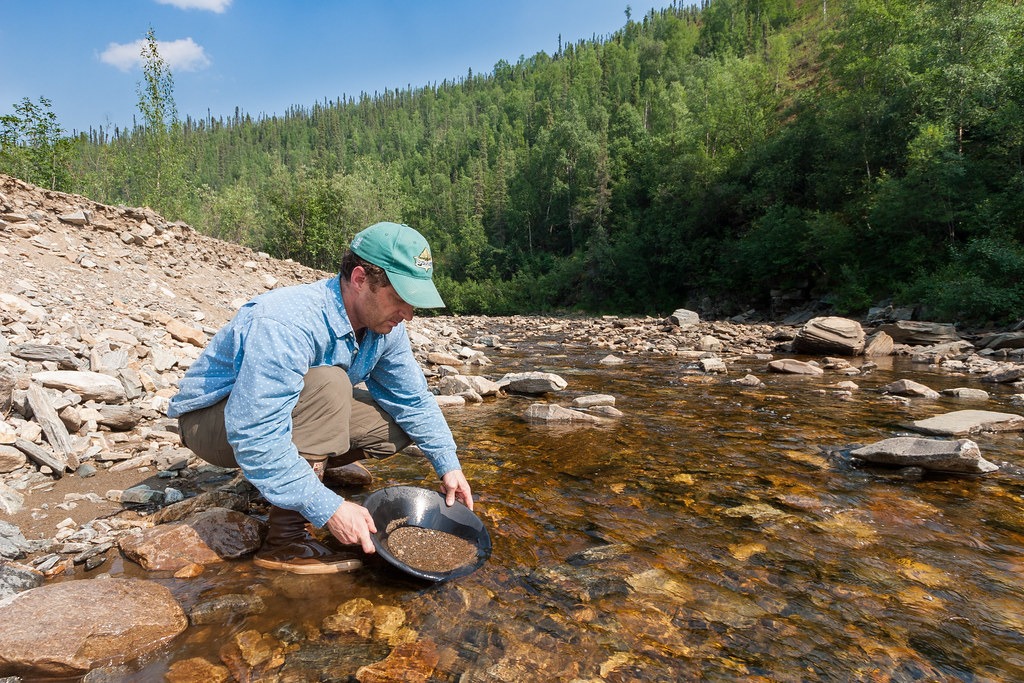
Gold panning is real. The gold is real. The history is real. The experience of kneeling beside a cold stream and watching black sand swirl in a pan until something bright catches the light—that is real, and for a lot of people, it is enough.
The complexity around it—land status, permits, claim checks, local rules—is also real, but it is manageable. It rewards patience and careful checking, and it punishes assumptions. Take the time to verify before you go. Ask the land manager. Look up the claim records. Read the local regulations. These steps are not obstacles designed to keep you out. They are the architecture of a system that tries to balance public access, private rights, environmental protection, and mineral development all at once. It is imperfect, but it is navigable.
If you decide to try it, start small. One pan, one classifier, one afternoon at a spot you have confirmed is open. See how it feels. See what you find—or do not find. Then decide whether you want to go deeper.
And if you decide it is not for you, that is a good outcome too. You looked into it, you understood what was involved, and you made an informed choice. That is better than most decisions people make about most things.
Thomas Holt • Geologist, Prospector, Writer