In most of the Western United States, there is a creek, a river, or a park within driving distance where you can show up with a pan and try your hand at gold panning—often closer than you’d expect. In the East and Midwest, options are thinner but they exist, especially through prospecting clubs, state parks, and pay-to-pan operations. What follows is a practical walk-through for finding a spot near you, choosing a good first-trip site, knowing what to bring, and setting realistic expectations for what you’ll find in the pan.
What “Near Me” Looks Like by Region
In Western states—California, Oregon, Washington, Idaho, Montana, Colorado, Nevada, Alaska—gold-bearing streams sit inside large blocks of public land managed by the BLM and Forest Service. Many of these are within a one- to three-hour drive of mid-sized cities. Southwest Oregon’s Rogue River corridor, stretches of the American River in California’s Sierra foothills, and creek systems across Colorado’s Front Range are the kinds of places that show up when Western prospectors search for gold panning near them. Public access points, maintained roads, and established recreational use make these approachable even on a first trip.
In the East, the geography is different. Most ground is private, so public-land panning areas are less common. But the southern Appalachians—parts of North Carolina and Georgia in particular—have historic placer districts with some recreational access. State-run parks, tourist-oriented panning sites, and club-held claims fill in the rest. If you are East of the Mississippi, “near me” may mean a guided experience or a club outing rather than a solo trip to a creek, and that is a perfectly good way to start.
How to Find a Spot
Three resources do most of the work.
Prospecting clubs are the fastest path for most beginners. Nearly every Western state has multiple clubs, and many Eastern states have at least one. They maintain lists of panning-friendly locations, organize group trips, and their members already know which areas are accessible and productive enough to be worth the drive. Membership fees are usually modest. The Gold Prospectors Association of America runs chapters across the country, and independent regional clubs—Portland Gold Prospectors, Eastern Oregon Mining Association, Willamette Valley Miners, and dozens of others—are easy to find with a quick search for your state.
State-published guides are the second resource. Several states put out recreational gold panning pamphlets, often as free PDFs from geological survey offices. Oregon has one. Washington publishes a “Gold and Fish” guide. California’s Department of Conservation maintains recreational mining information. These guides list open areas, describe any restrictions, and save hours of independent research. If your state has one, start there.
Land management agency websites and offices are the third. The BLM and Forest Service both publish jurisdiction maps online, and their local district offices will answer a direct question—“Is hand panning allowed on this stretch of river?”—by phone or email. They will also tell you about any seasonal closures or site-specific rules. A five-minute call can confirm what an hour of internet searching leaves ambiguous.
Choosing a First-Trip Site
Not every legal spot is a good first spot. For an initial outing, look for a site that is easy to reach (maintained road, reasonable parking), has moderate water flow you can work comfortably in, and sits in a watershed with at least some history of placer gold. You do not need a legendary district. You need a place where the streambed has the right kind of material—gravel, cobble, exposed bedrock with crevices—and where you can spend a few unhurried hours learning what your pan does in moving water.
Designated panning areas are ideal for a first trip. Oregon’s Gold Nugget Waysides along the Rogue River near Gold Hill, for example, are small public access points specifically open to recreational panning. California’s Auburn State Recreation Area offers similar low-barrier access. Sites like these remove most of the guesswork and let you focus on the experience itself rather than logistics.
If you are working from a club list or a state guide, look for entries described as “recreational,” “hand tools only,” or “public access.” These tend to be the most beginner-appropriate. Rich-sounding names or references to historic production are interesting, but accessibility and comfort matter more on your first day out than geology does.
Common Mistakes When Searching for Gold Panning Near You
The most common mistake is picking a spot based on excitement rather than verification. A creek that looks perfect on a YouTube video may be on private land, inside an active claim, or closed for the season. A few minutes of checking with the land manager or a club contact prevents a wasted trip—or worse, an awkward one.
The second mistake is driving too far for a first outing. A three-hour drive to a famous district sounds appealing until you realize you spent more time in the car than at the water. Start close. Even a modest, nearby site teaches you more about panning on your first day than the best site in the state would if you arrive tired and rushed.
The third is over-researching geology and under-researching access. Historic mine maps and geological surveys can narrow where gold has been found in the past, and clubs often know which historical districts are still worth exploring. But the practical question—can I get to this spot, park, and pan without a problem—matters more on day one than the district’s production history.
What to Expect When You Get There
Most recreational panning sites in well-known districts will produce fine gold—small flakes, sometimes just specks visible against the dark bottom of your pan. A few hours of steady work on decent ground might yield a small pinch of color. Some days, nothing at all. The richest surface deposits were worked over generations ago, and what remains is real but modest.
That is normal, and most people who come back for a second trip already know it. The draw is not the yield. It is the process—reading the stream, watching the material stratify, learning which gravel bars are worth sampling and which are not. People who enjoy gold panning tend to enjoy it for the same reasons people enjoy fishing: the time outside, the quiet focus, and the occasional small reward that makes the next hour feel worth trying.
Quick note: before your first trip, confirm with the land manager or site listing that the area is currently open and check whether active mining claims affect the specific stretch you plan to visit—this takes minutes and avoids the only common access issue recreational panners run into.
Your Next Step
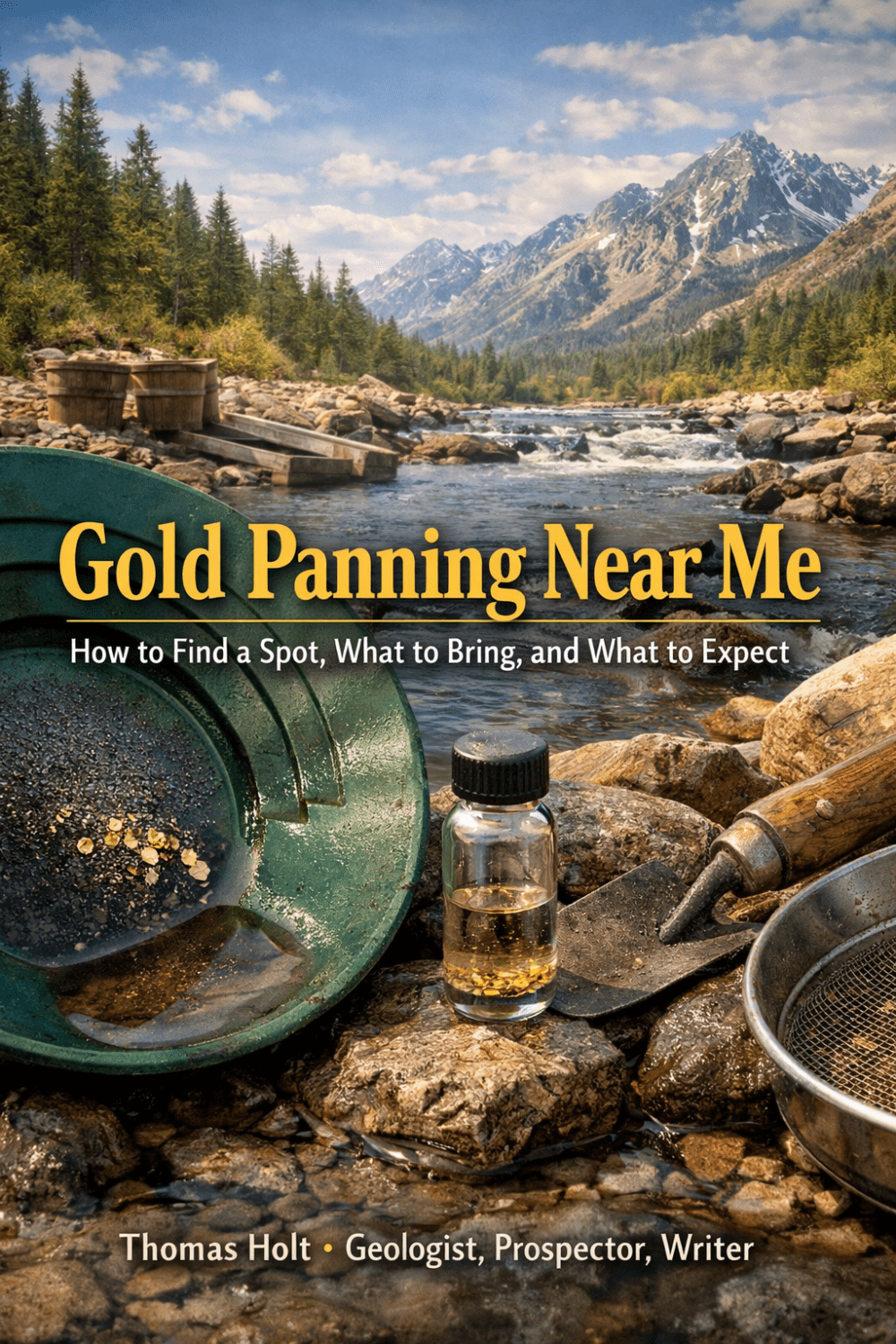
Pick one resource—a club, a state guide, or a land agency website—and look for the nearest panning-friendly site to where you live. Confirm it is open, note any restrictions, and plan a half-day trip with minimal gear: a pan, a classifier, a trowel, a small vial, and shoes that can get wet. That is enough for a first outing. Everything else—better technique, preferred spots, whether you want to keep going—comes from time at the water, not time on the internet.
If nothing turns up close by, a club membership or a pay-to-pan site gets you to a pan and a stream with almost no research overhead. Neither is a compromise. Both are where a lot of experienced panners started.
Thomas Holt • Geologist, Prospector, Writer