Virginia Lynn
📍 Colorado
$1,000,000
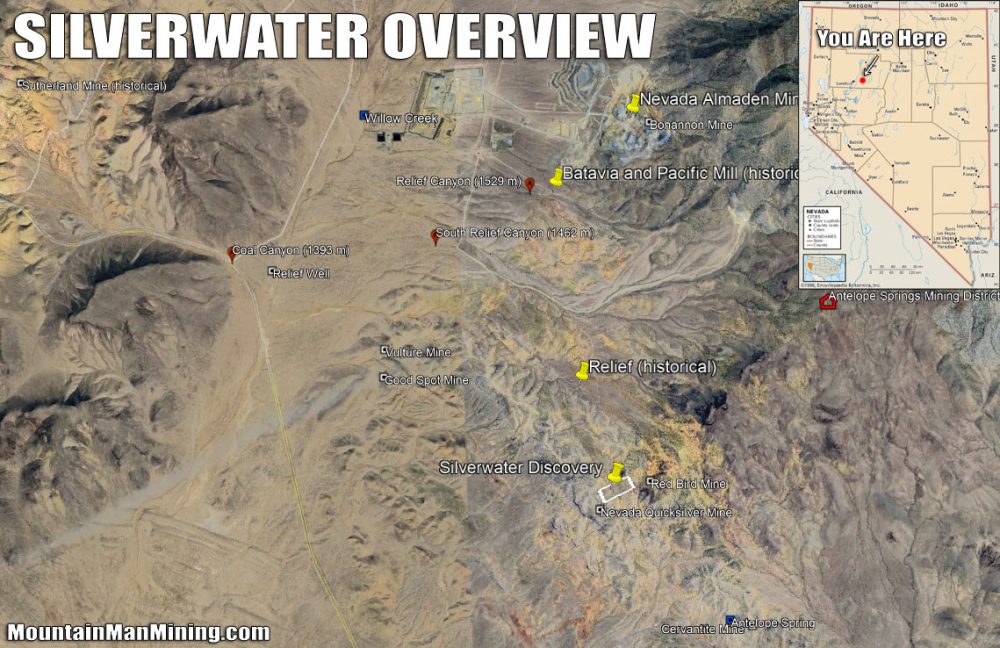
20 Acre Unpatented Lode Claim · Silverwater District · Nevada, Pershing County
Silverwater — formerly the Nevada Quicksilver Company mine — was a 20.66-acre unpatented lode claim in Pershing County, Nevada, the leading U.S. mercury producer from 1928–1929.
Type of Claim: Unpatented Lode (NMC #106736220)
Size of Claim: 20.66 Acres
Mining Commodities: Mercury, Gold, Silver
State/County: Nevada, Pershing County
Accessibility: Occasionally rough dirt roads — 4x4 recommended
Closest City: Lovelock, Nevada
Camping: Yes, up to 14 days at a time
Prior Workings: Significant — thousands of tons
Cell Phone Reception: Sparse — GPS recommended
Discovery Monument (GPS): 40.165188°, -118.178285°
Once a highly sought-after commodity, mercury (quicksilver) played a critical role in various industries, from electrical apparatus and dental preparations to its historical use in recovering gold. While mining mercury directly for profitability is questionable today, nearly all mercury deposits in this geological area also contain gold.
Cinnabar — mercury(II) sulfide, a striking scarlet-to-brick-red mineral — is the most common and historically important ore of mercury, often found in vein-filling deposits associated with volcanic activity and hot springs, environments that are also prime for gold formation. While gold isn't chemically bound within cinnabar itself, its presence alongside cinnabar indicates a shared geological origin, and geochemical studies show gold deposits formed at low-to-intermediate temperatures can carry higher mercury concentrations.
Cinnabar occurred here in limestone as rich bunches and pods, and also formed disseminated crystals in white calcite veinlets cutting the limestone. Ore from the upper mine workings contained stibnite; lower levels held scattered pods of ore with a higher stibnite percentage. Both ore bodies lay in limestone conglomerate close beneath the contact, in places touching the shale directly, with the largest ore body localized between two intersecting steep faults along a major northwest-trending deposit of upper Triassic and lower Jurassic sedimentary rocks.
The remnants and concrete foundation of the old mill site remained intact. Multiple shafts and workings sat on the 20.66-acre lode property. Past production reached up to 46 pounds of mercury per foot of vein material, with gold, silver and antimony also present. Actively mined from 1928–1943, the mine produced 3,259 flasks of mercury by the end of 1943 (roughly 1,016 pounds per ton), with extremely high-grade cinnabar ore running 20–40 pounds of mercury per ton. Hundreds of tons of unprocessed high-grade ore remained on the surface.
Economic Profile: Underground-lode operation, past-producer development status, gold/silver/mercury commodity type, very significant deposit size. Mining District: Antelope Springs, Pershing County. Deposit MAS/MILS ID: 10040306 (MRDS Deposit “Juniper”).
Geologic Structure: Lode in volcanic rock (aphanitic mafic volcanic/basalt), sedimentary carbonate (limestone), and diabase dikes.
We list new claims weekly. Browse our current inventory or get notified when claims matching your criteria become available.
Browse Active Listings Get NotifiedThis claim has sold, but these active listings are available right now: