 New
Lode
New
Lode
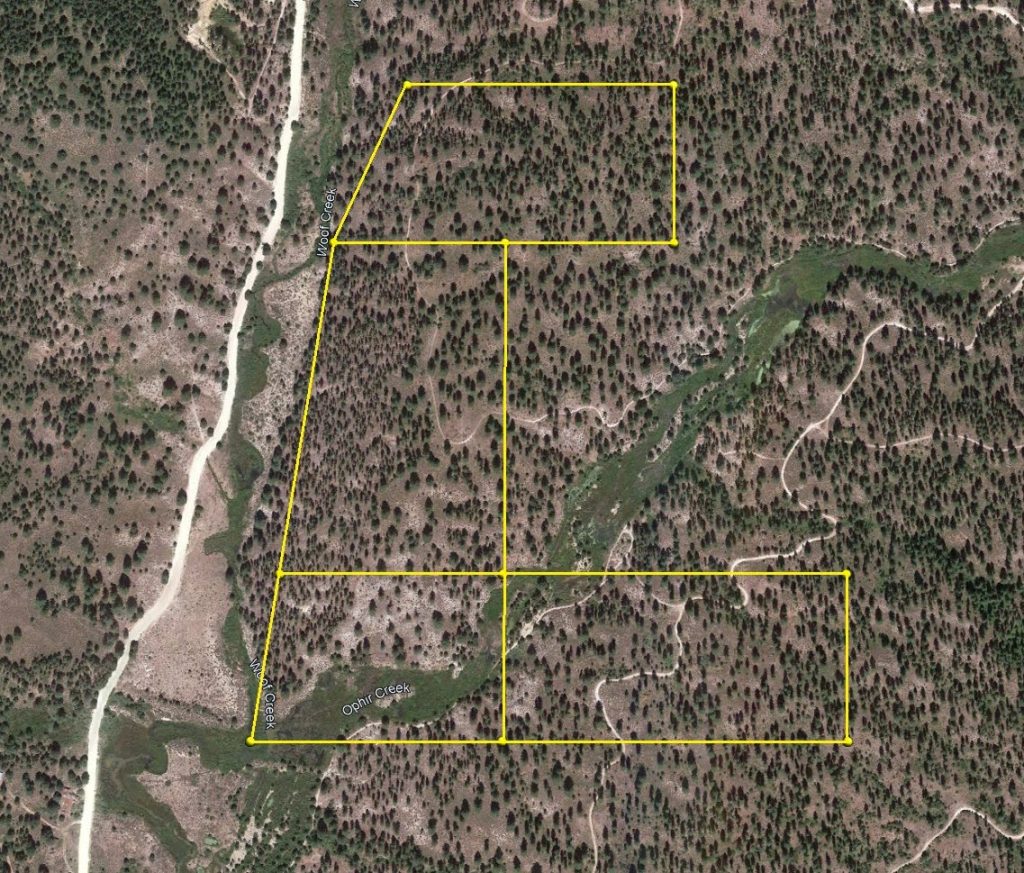
Boulder #2 & #3
📍 Boise County, Idaho
- Au
- Ag
$15,000
87.64 Acre Lode Mining Claim · Rico District · Dolores County, Colorado
$1,000,000
All BLM & county filing fees included. 10-day transfer guaranteed.
Unpatented Colorado Lode Mine for Sale
“A proven polymetallic copper-silver-gold lode mine with platinum group elements, existing underground workings, a 70+ year documented history, and ore that has already been shipped to smelter… What could be better than the Virginia Lynn?”
Copper Gulch • Dolores County • Colorado • San Juan National Forest
Tucked in the timbered slopes of Copper Gulch on the south side of the Willow Divide in Dolores County, Colorado, the former Little Silver Mine, a 82.64-acre lode mine with 5-acre mill-site, now known as the Virginia Lynn, sits on a rare spot on the planet.
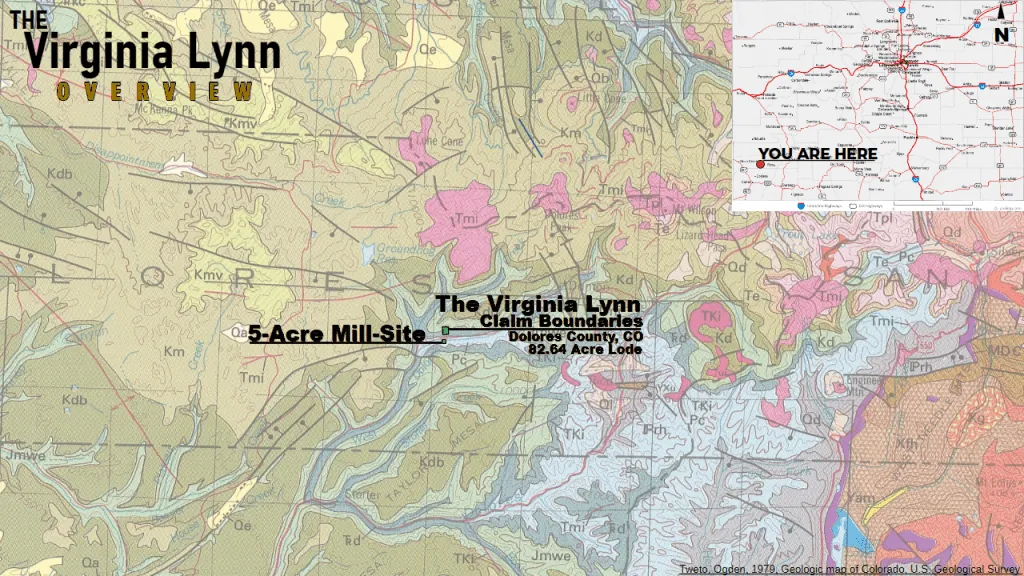
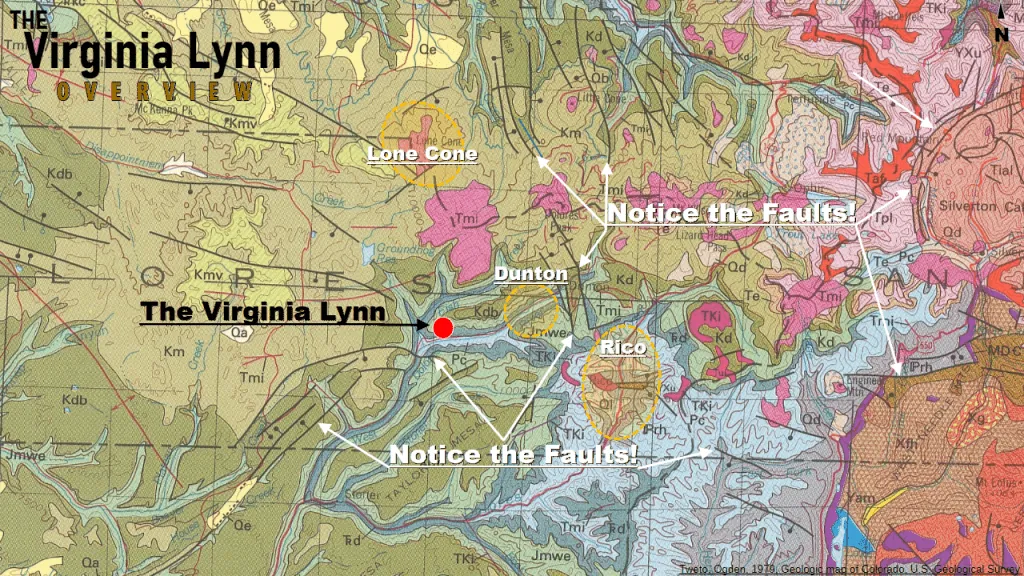
The claims find themselves centrally located on an extensive fault network on the San Juan Mountains, created from the clash of the intrusive San Juan Volcanic Fields and the pre-existing Mesozoic/Paleozoic rock structures. This clash created huge faults spanning for tens of miles all around the claim, and left a particularly dense cluster of breaks that Virginia Lynn sits square on top of. This fault network hosts some of the highest-grade copper deposits found in recent history. Silver is found in commercial quantity, and gold is sprinkled within.
Uninterested in commercially developing the property themselves, the owners of this claim have decided to open this well-guarded gem for sale to the public, in hopes of seeing the legacy of this centuries-old mine be carried on…
With over 70+ years of recent, well-recorded history, the Virginia Lynn claims have been formally examined by the U.S. Forest Service and the Bureau of Mines on multiple occasions — in 1973, 1977, 1988, and 1990 — with each examination confirming the presence of valuable copper-silver mineralization (reports downloadable here!). The 1988 Forest Service Mineral Report concluded that the land contains mineral values sufficient to justify extraction, and numerous assays of the property’s ore reconfirm the same sentiment.
Federal examinations and personal assays made by the long-term owners identified other key minerals: platinum, palladium, titanium, and consistently high amounts of barium. The presence of these commercially valuable minerals found within target ore is a notably good sign, pointing to higher returns and less costly gangue material waste when processing.
There’s evidence too that suggests this mine was opened and worked long before the historic mining boom at nearby Rico, possibly as early as the mid-1800s. With early prospectors having entered this very same mine earlier than the birth of the Rico mining district, the echoes of your footsteps through the portal of the Virginia Lynn is the same echo heard centuries ago by some of Colorado’s earliest prospectors.
“Observable geologic features, sampling and assay results, proximity to past producing mines, and favorable geologic conditions all indicate that the land contains mineral values which would render their extraction profitable.”
Andrew G. Raby, USDA Forest Service Mineral Report, 1988
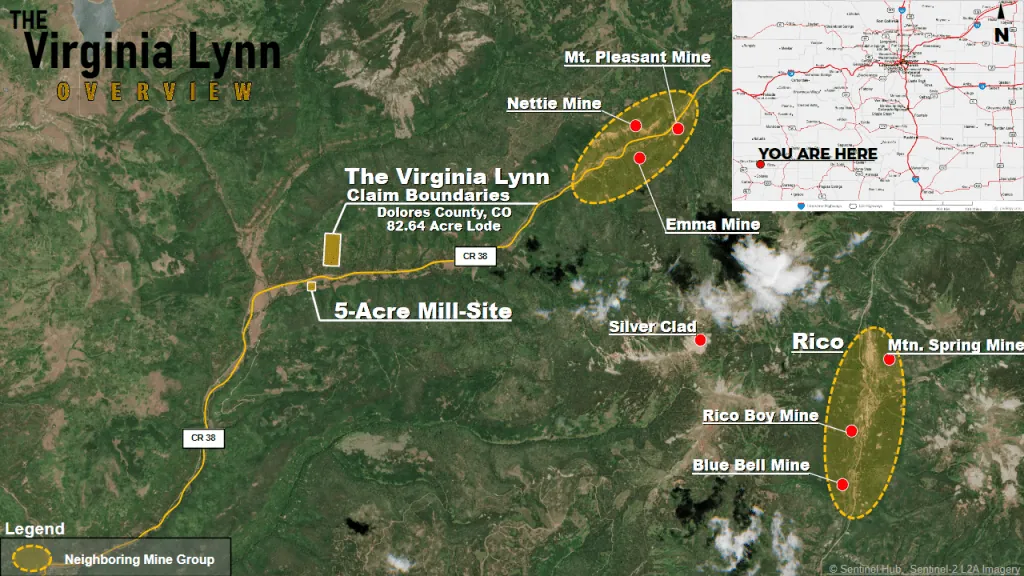
The Virginia Lynn claim group lies near the Rico Mountains intrusive complex, at the center of an extensive fault system on the Willow Divide with subparallel and continuous faults radiating 20 to 30 miles to the East and West from where the Virginia Lynn sits. This intrusive complex is the geologic engine that powered the legendary Rico and Lone Cone mining districts to the East and their rich precious-metal deposits — the Virginia Lynn sits within the same regional fault system, though our own 1986 Forest Service report is explicit that this claim's copper mineralization formed through a different process than Rico's classic veins (more on that below).
The primary mineralization is structure-controlled — hydrothermal fluids migrated along faults and invaded the sedimentary country rock, fracturing it and depositing copper, silver, and gold wherever they found favorable conditions – conditions like what we see in the Virginia Lynn; the breccia dike exposed in the crosscut, the fault-controlled coaly layers, and the extensive fracture network all point to a robust mineralizing system with significant depth potential.
Further, Federal reports suggest the Virginia Lynn finds itself in a very unique area. Capturing three separately formed specimens of copper; oxide-zone, supergene enriched-zone, and sulphuric copper mineralizations, give hints as to where the Virginia Lynn sits in relation to the original igneous intrusion. With the Virginia Lynn already seeing these highly-enriched supergene minerals, it’s highly likely the mine has penetrated past the oxidized zone and into a local enrichment band, on-course to discover the igneous source at its root!
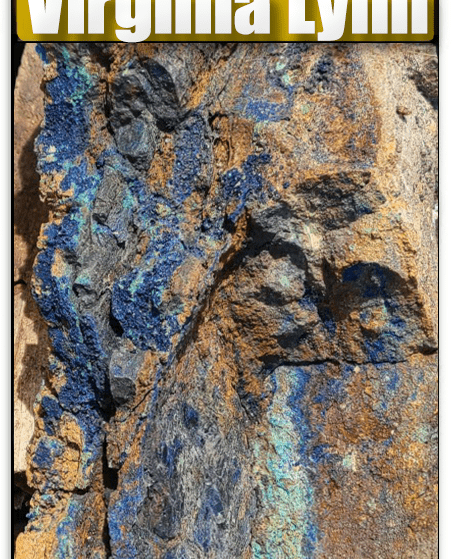
The 2023 XRF spectrometer analysis confirmed a rich polymetallic suite far beyond copper alone. Samples returned extraordinary copper values — up to 27.9% Cu in the named “Blue Rock” sample, others seen as high as 33.8% Cu — along with elevated arsenic, barium, fluorine, and sulfur, all hallmarks of a deep-seated hydrothermal system. The detection of platinum and palladium adds a dimension that the original Forest Service examiners never explored.
The 1986 Forest Service examiners’ own field read on the mineralized structure describes it as extending “several hundred yards along the fault zone, several tens of yards in width, and tens to hundreds of yards vertically” — a geologist’s estimate of a structure’s size, not a resource estimate, since nobody has drilled to confirm it. The same report is direct about genesis, too: it describes the Virginia Lynn’s mineralization as breccia-hosted and structurally controlled, and states plainly that it “is not similar to the Rico deposits” a few miles east — a different ore-forming system, not a smaller version of the same one.
“The copper present is … heavy black metallic black Chalcocite (copper and sulphur) and a little dark green Malachite (copper carbonate). The copper and silver contents are of commercial interest and value.”
— Ed Phillips, The Colorado Assaying Company, 1986
The mineralization seen here produces something uncommon in the world of copper deposits: nuggets up to two inches across with dark, heavy chalcocite and bornite cores wrapped in vivid blankets of green malachite, deep blue azurite, and possible indigo covellite. That kind of natural color zonation — black to iridescent purple to green to blue – suggest five separate combinations of copper and minerals that create beautiful palm-sized specimens; a hand-held kaleidoscope of the mineralogy under the feet of everyone hiking the Willow Divide.
But there’s more for show under the earth here. The 1986 Colorado Assaying Company spectrographic analysis described the host rock as a fine-grained siltstone of white feldspar, quartz sand, flake mica, and soft limestone — a clean, contrasting backdrop that makes the minerals pop. Fracture surfaces throughout the accessible workings are stained with malachite and azurite. Ruby silver (pyrargyrite), cinnabar, arsenopyrite, and marcasite have been reported and also make an occasional display.
Want the full paper trail — every USFS examination, every lab certificate, back to 1952?
Page 2: The Historical Record →If you’re interested in purchasing this unpatented Colorado mine for sale, please email me here.
| Type of Claim | Unpatented Lodes & Millsite; CO106318746(-50) |
|---|---|
| Size of Claim | 82.64 ACRES + 5 ACRE MILL |
| Mining Commodities | Gold, Silver, Copper, Gems |
| Accessibility | Paved Roads + Dirt Roads |
| Closest City | Rico, Colorado |
| Camping | Yes. Up to 14 days at a time |
| Prior Workings | None |
| Cell Phone Reception | Spotty on AT&T Networks |
| Type of Deposit | Lode |
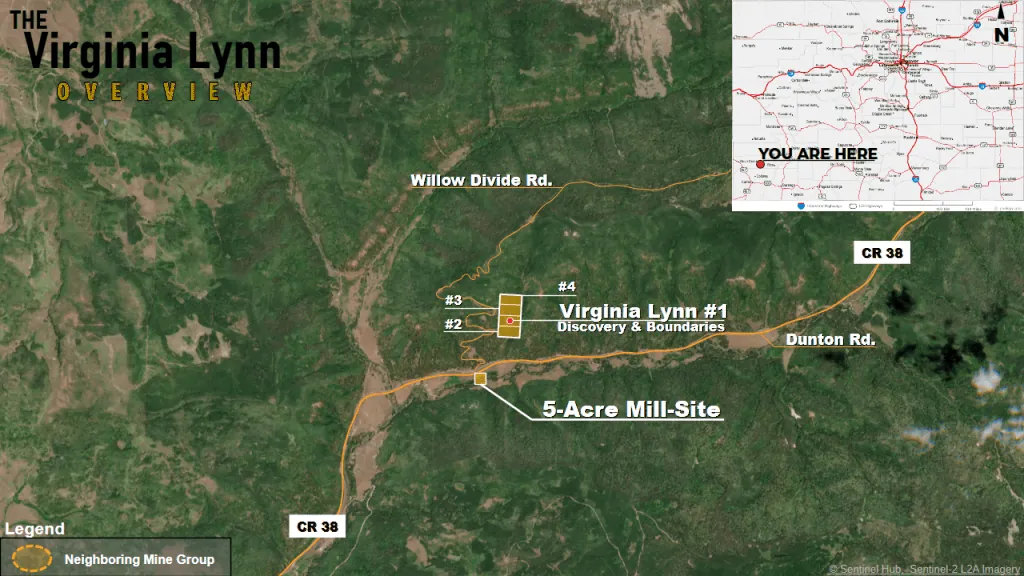
| NE | 37.738801°, -108.213278° |
|---|---|
| NW | 37.738932°, -108.218489° |
| SE | 37.732228°, -108.213587° |
| SW | 37.732328°, -108.218847° |
| NE | 37.726957°, -108.221395° |
|---|---|
| NW | 37.726947°, -108.223005° |
| SE | 37.725677°, -108.221404° |
| SW | 37.725674°, -108.223030° |
| Operation type | Lode |
|---|---|
| Development status | Established Discovery |
| Commodity type | Gold, Silver, Copper, Gems, Lead, Zinc, Molybdenum |
| Deposit size | Unknown |
| District Name | Dunton, Dolores County |
|---|---|
| Deposit MAS/MILS ID |
Emma Mine – MRDS #10166487 Rico Boy Mine – MRDS #10118566 Mountain Spring Mine – MRDS #10239264 |
| Type of Structure | Dolores FM |
|---|---|
| Structure Description |
(MAJOR) — Sedimentary Sedimentary > Clastic > Siltstone Sedimentary > Clastic > Mudstone > Shale Sedimentary > Clastic > Sandstone Minor — Sedimentary Sedimentary > Clastic > Conglomeratelimestone-pellet conglomerate |
A mining claim gives the holder the right to mine on mineral-rich land that belongs to the federal government. Mining claims are a tangible asset and show proof of all interests in minerals in the area. They can be bought, sold or used as collateral, just like any other piece of real estate.
A mining claim can be sold, traded, leased, gifted, willed, used as collateral or transferred in part or in its entirety just like any other real property using a quitclaim deed which is a recordable conveyance. Questions about the transfer process can be answered by contacting us anytime. All fees and paperwork current and assessment fees are paid through Sept. 1st 2026.
$1,000,000
Make an Offer
Have questions? Concerns? Want to see the mine in person? Contact us! Make an offer on the Virginia Lynn.
Contact UsAfter your purchase is complete you will be requested to fill out our new claim owner form with your name/address or add any additional claimants you want on the claim.
You’ll get digital copies of your COL and Map of Location in to your claim(s) will be delivered via email via PDF format as well as Google Earth™ KMZ map file with your claims discovery, corners and points of interest.
We handle all the filing and transfer services on your behalf. Expect to get official stamped/recorded copies of your paperwork mailed to you from the Dolores County Recorder’s Office and the Colorado Bureau of Land Management officiating you as the new claimant within 45 days of purchase. Then officially enjoy mining gold on your own land!
The Virginia Lynn is a significant lode mining claim located in the historic Rico District of Dolores County, Colorado. The district has a long and productive history of silver, gold, and base metal mining dating back to the late 1800s.
Primary and secondary commodities on this claim include:
The Rico District is underlain by Tertiary volcanic rocks and associated intrusive bodies that host polymetallic vein and replacement deposits. Historic production from the district has included significant quantities of silver and gold, with associated copper, lead, and zinc values. The presence of molybdenum and platinum group elements (PGE) on this claim adds to its polymetallic potential and exploration upside.
The Virginia Lynn claim is situated within the Colorado Mineral Belt, a northeast-trending metallogenic province that has produced some of the most significant mineral deposits in the United States. The claim area is characterized by:
The 87.64-acre footprint provides substantial ground coverage over the mineralized trend, offering both immediate development potential and long-term exploration upside. The claim's size and location make it suitable for small-scale to medium-scale mining operations.
The Rico District has been an important producer of silver, gold, lead, zinc, and copper since the 1880s. The district is centered around the town of Rico, Colorado, and encompasses a large area of altered volcanic terrain with numerous mines, prospects, and mineralized structures.
Historic production figures from the district are substantial, with millions of ounces of silver and significant gold credits recovered over more than a century of intermittent mining activity. The district saw renewed interest during periods of high metal prices, and modern exploration techniques continue to identify new targets within the established mineralized trends.
The Virginia Lynn claim sits within this proven mineralized corridor, offering both the security of a historic district and the upside of underexplored ground.
Want the full paper trail — every USFS examination, every lab certificate, back to 1952?
Page 2: The Historical Record →Satellite view of the claim area. Click the pin for a quick summary.
Exact claim centroid shown on satellite imagery — computed from the claim's published corner coordinates.
Explore other active lode and placer claims.
Every claim currently for sale, sorted by price. Tap a name to open the full listing.
| Claim | Price | Commodity | County / State | Acreage |
|---|---|---|---|---|
| The Virginia Lynn you’re here | $1,000,000 | Silver, Gold, Copper +4 | Dolores County, Colorado | 87.64 |
| The Sedona Legend & Sunrise Claims | $71,980 | Gold | Yavapai County, Arizona | 80 |
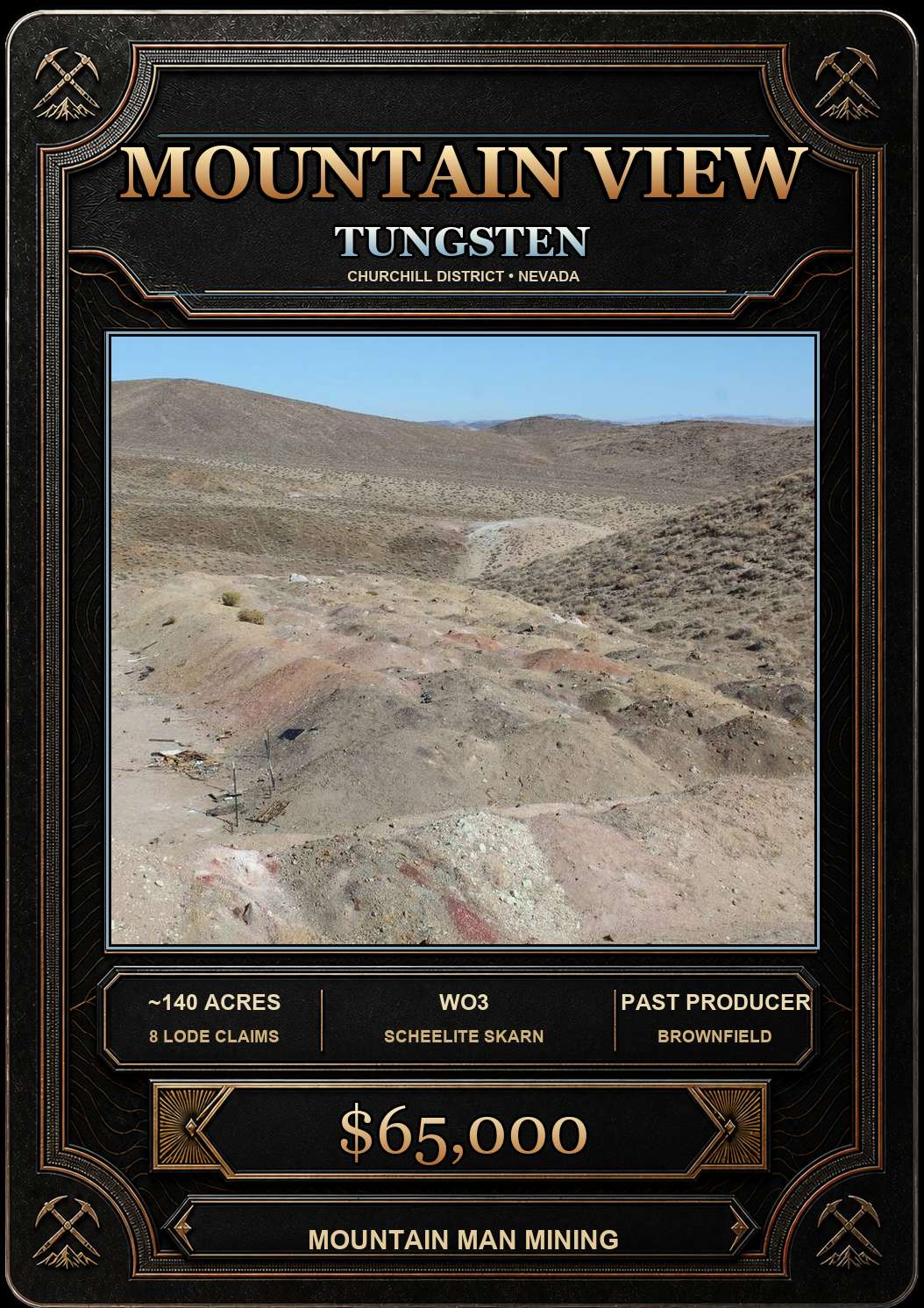
| Mountain View Tungsten Project | $65,000 | Tungsten, Copper | Lyon County, Nevada | ~140 |
| Ophy I-V Claims | $41,250 | Gold, Silver, Copper | Boise County, Idaho | 79.35 |
| Sunny Side Up #1-2 | $21,500 | Gold, Silver | Southeast Fairbanks, Alaska | 80 |
| Boulder #2 & #3 | $15,000 | Gold, Silver | Boise County, Idaho | 41.32 |
| The Winna-Winner Claims | $10,000 | Gold, Silver, Iron +2 | Humboldt County, Nevada | 40 |
| Belcher Canyon | $9,997 | Gold | Nye County, Nevada | 20 |
| The Golden Trinity Claim | $8,000 | Gold, Platinum, Silver | Trinity County, California | 20 |
| Marigold #1 | $7,500 | Gold, Silver | Yavapai County, Arizona | 20 |
| Ayers Claim | $6,500 | Gold, Silver | Sierra County, California | 20 |
Prices and availability change as claims sell. Ask about any of these or see what has already sold.